
Wednesday, March 6, 2013

Wednesday, February 6, 2013
Insect Grooming Improves Olfactory Function

Researchers at NC State University set up experiments to explore insect grooming. They compared cleaned American cockroach antennae to antennae that was not cleaned. It was found that the uncleaned antennae accumulated volatile and non-vola...tile chemicals as well as waxy secretions that protect the cockroaches from water loss.


It was found that the groomed antennae were more able to detect sex pheromones and other odors. The bugs with the groomed antennae were able to respond to these odors faster.
This research could be useful in insecticide application and other studies using insects.
Full Story: http://www.sciencedaily.com/releases/2013/02/130204153603.htm
Photo: http://tinyurl.com/akr42ue
This research could be useful in insecticide application and other studies using insects.
Full Story: http://www.sciencedaily.com/releases/2013/02/130204153603.htm
Photo: http://tinyurl.com/akr42ue
Monday, February 4, 2013
Fuel for Insects, Fuel for Cars: Using Gut Microbes and Enzymes as a Catalyst to a New Future of Biofuel
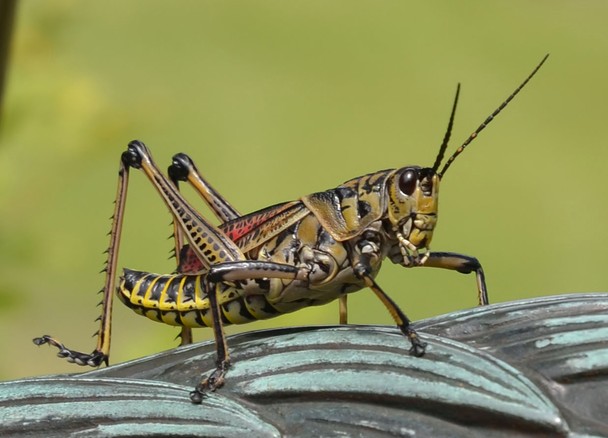
The key to converting lignin to ethanol may be in the guts of insects. Herbivorous insects host an array of microbes and enzymes in their guts that break molecules, like cellulose and lignin, down. A recent study compared the genome of microbes found in grasshoppers, cutworms, and termites and linked the diversity and ability to break down those components to the diet of the species. In the words of the corresponding author, Joshua Yuan, "The study reveals that insect gut microbes evolve to adapt to different food types."
A grant from The U.S. Department from Energy will help Yuan and his fellow researchers at Texas A&M University explore enzymes found in termite guts and microbes as a way of using lignin for biofuel.
Story: http://tinyurl.com/abnwdwz
Photo: http://tinyurl.com/a66d4aq
Wednesday, January 30, 2013
Sex Ratios in Social Insect Colonies


In termite societies this is not the case. The males and females share the work, and therefore the sex ratio is more or less even. This suggests that the sex ratio of social insects is biased towards the sex of the species that helps the colony.
Read more: http://phys.org/news/2013-01-babies-insect-sociality.html
http://www.zoo.ox.ac.uk/group/gardner/publications/GardnerRoss_InPress.pdf
http://en.wikipedia.org/wiki/Haplodiploidy
Photo: http://tinyurl.com/a7uxsck

http://tinyurl.com/ajwocvb
Friday, January 25, 2013
Researchers Find Dung Beetles Are Able to Use The Milky Way for Orientation

Male dung beetles roll animal feces into balls in order to attract females. The dung serves a purpose as well, food for the young larvae when the female accepts her gift and mates with the male. Like many other animals, the males have competition: other males. Competitors will steal a ball of dung before the hard-working male can deliver it to his potential mate.
To avoid having the smelly gift stolen, a male needs to make a quick getaway from the dung pile. This involves moving in a straight line. Researchers observed that on moonless nights the beetles were able to travel in a straight path.
Experimenters set out to study this observation and found the beetles were able to use the milky way, rather than individual stars, as well as the moon, to navigate. They also found that navigation was more difficult in overcast conditions or if the insects were otherwise hindered by sight.
Full Story: http://tinyurl.com/a6rgums
Photo Credit: http://tinyurl.com/acxfbfc
Summary, figures & tables: http://tinyurl.com/akqjec6
Wednesday, January 23, 2013
Lucy the Madagascar Hissing Cockroach
Subscribe to:
Posts (Atom)